Post #1 opened this series with a single, unglamorous fact: a CPU repeats fetch, decode, execute, billions of times per second, and everything else in computing is built on top of that. Nineteen posts later, this series has covered data structures, algorithms, networking, databases, operating systems, cryptography, system design, patterns, and compilation — and every single one of them still, ultimately, reduces to that same fetch-decode-execute cycle. This final post looks at where the field is heading, with particular attention to a question this blog’s extensive AI coverage elsewhere has not directly addressed: how do these twenty posts’ fundamentals actually relate to the large language models this blog covers so extensively in its other series?
How This Series’ Fundamentals Underlie the AI Landscape
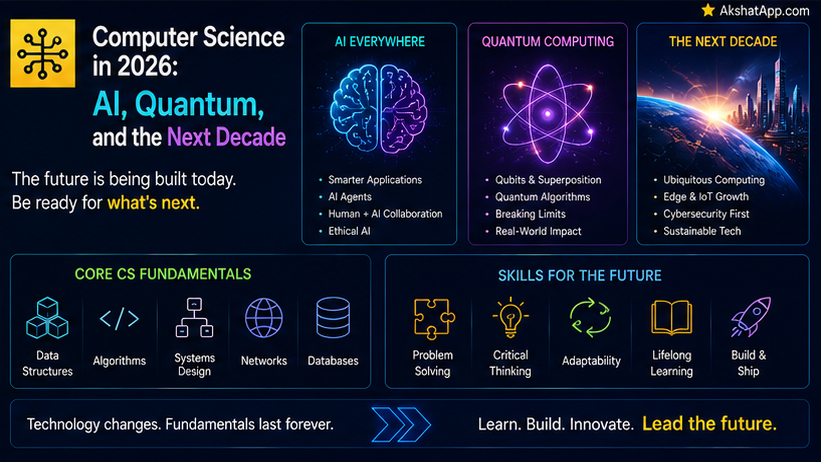
This blog’s Claude, ChatGPT, Google AI, Ollama, and Perplexity series cover what these systems do — write code, answer questions, search the web with citations. None of them needed to cover what makes these systems possible to build and run at all, because that story is precisely this series’ twenty posts, applied at an enormous scale.
Data structures, at scale: A language model’s core operation — finding which stored pieces of information are most relevant to a given query — relies on structures directly descended from Post #4’s hash tables and Post #5’s trees, adapted for high-dimensional vector similarity search rather than exact key matching, but built on the identical underlying principle: organize data so the right piece can be found without checking everything.
Algorithms and Big O, at scale: Training a large model involves an almost unimaginable number of the same fundamental arithmetic operations Post #1 covered for a single CPU cycle — and every optimization technique used to make that training tractable is a direct descendant of Post #7’s discipline: understanding exactly how work scales with input size, and finding algorithmic improvements before reaching for more raw hardware.
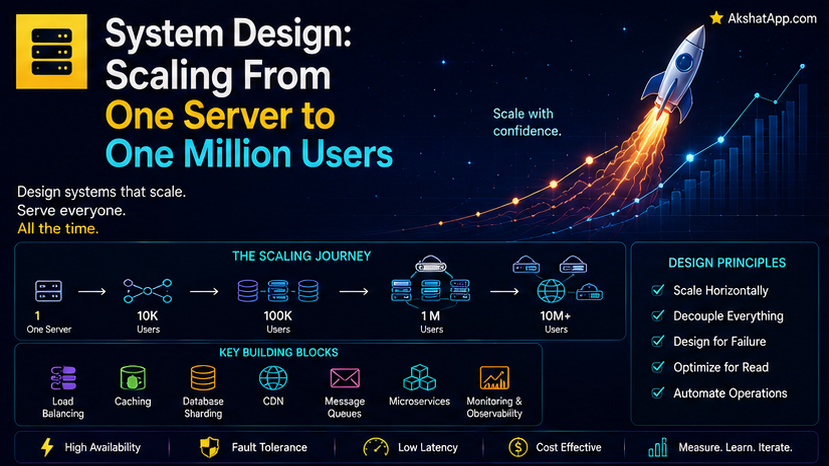
System design, at genuinely enormous scale: Post #17’s staged scaling journey — caching, load balancing, distributed databases — describes, in miniature, precisely the engineering challenge of serving millions of simultaneous requests to a language model reliably and quickly, just with dramatically larger numbers at every stage.
Operating systems and hardware, still the foundation: Every model referenced throughout this blog’s AI coverage ultimately executes as Post #1’s fetch-decode-execute cycle, scheduled by Post #15’s operating system concepts, across specialized hardware built specifically to accelerate exactly the kind of arithmetic these systems perform in enormous volume.
The honest, important point this section is making: AI has not replaced the need for this series’ fundamentals — it is one of the most demanding, large-scale applications of them currently in existence. Understanding data structures, algorithms, and systems design remains directly relevant to understanding how the AI tools covered extensively elsewhere on this blog actually work underneath, not a separate, older body of knowledge AI has superseded.
Quantum Computing: An Honest, Hedged Look
Quantum computing represents a genuinely different computational model than everything covered in this series — rather than Post #1’s definite, binary 0-or-1 states, quantum computers exploit superposition and entanglement to represent and process information in fundamentally different ways, with the potential to solve certain specific categories of problems (particularly some involving Post #6’s graph and search-related structures, and specific cryptographic problems directly relevant to Post #16) dramatically faster than any classical computer built on this series’ architecture ever could.
What this post will not do: make confident, specific claims about quantum computing’s practical timeline or near-term impact on everyday software development. This remains a genuinely active area of research and engineering, with real progress and real, substantial remaining challenges, and specific claims about exactly when quantum computing will meaningfully affect the kind of work this series has covered deserve the same epistemic caution this blog applies to any other actively-developing, uncertain technical frontier. What is reasonably confident: the fundamentals covered throughout this series — algorithmic thinking, complexity analysis, data structure design — remain directly relevant skills for understanding quantum computing’s genuine capabilities and limits, even as the underlying hardware model differs fundamentally from everything covered here.
The Complete Series Retrospective
A direct walk through how every post connects to the others, since this connectedness has been this series’ consistent, deliberate design:
Post #1-2 (Hardware and binary) established the absolute foundation — everything else in this series ultimately reduces to these two posts’ content.
Post #3-6 (Data structures) gave you the vocabulary for organizing information — arrays and linked lists’ tradeoffs, hash tables’ O(1) average case, trees’ ordering, graphs’ full generality.
Post #7 (Big O) made every one of those structures’ performance claims precise and comparable, retroactively formalizing everything covered before it.
Post #8-12 (Algorithms) applied that vocabulary directly — sorting and searching built on Post #3-6’s structures, recursion as the mechanism underneath tree and graph traversal, dynamic programming fixing recursion’s redundant-computation problem, greedy algorithms offering a faster but conditionally-correct alternative.
Post #13-16 (Systems) took this series outward, from a single machine to networked, database-backed, secured systems — with Post #14’s indexing directly, literally reusing Post #4 and Post #5’s structures, and Post #15’s operating system content explaining how Post #1’s single-CPU model scales to running many programs at once.
Post #17 (System design) synthesized every systems post into one coherent, staged architecture, with Post #1’s memory hierarchy principle reappearing, transformed, at every single stage.
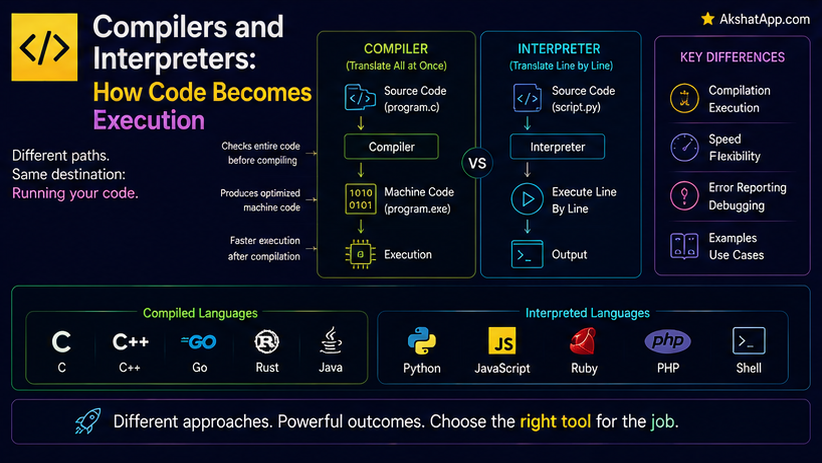
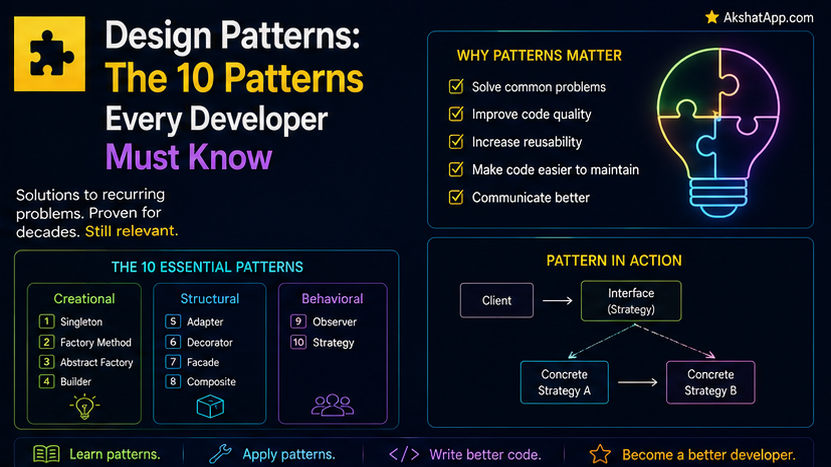
Post #18-19 (Patterns and compilation) closed the loop — recurring solution shapes already present throughout this series, finally named directly, and the complete pipeline from the readable source code used in every single code example in this series back to Post #1’s fetch-decode-execute cycle.
This was always the point: not twenty disconnected topics, but one coherent body of knowledge, each post’s foundation genuinely load-bearing for what came after it.
Final Capstone Exercise
Bring the entire series together one final time. Pick a real, existing software system you use regularly (a messaging app, a music streaming service, an online store), and write a short analysis addressing:
- What data structures (Posts #3-6) is it very likely using internally, and why those specifically?
- What’s the Big O (Post #7) of its most important, frequent operation — searching, loading your feed, processing a transaction?
- Sketch its likely system architecture (Post #17) — where would caching, load balancing, and database scaling most plausibly appear?
- What cryptographic protections (Post #16) does it need, and where specifically?
- Which design patterns (Post #18) can you identify or reasonably infer from its behavior?
Completing this analysis is the clearest possible demonstration that this series’ twenty posts have become one genuinely integrated way of looking at real software, not twenty separate facts.
FAQ
Q: Is this series’ content still accurate as the field continues to evolve? A: The fundamentals covered throughout this series — data structures, algorithms, networking, database and OS concepts, cryptography, and how code becomes execution — have remained stable for decades and are unlikely to become outdated the way specific tools or frameworks do; this is precisely why this series was built around fundamentals rather than currently-fashionable technology specifics.
Q: Should I learn a programming language before or after a series like this? A: This series used Python throughout specifically because this blog’s Python Unlocked series already provides that foundation — working through both together, or Python first, gives you both the practical syntax and the underlying theory reinforcing each other directly.
Q: Is understanding these fundamentals still valuable if AI tools can write code for me? A: Directly relevant to this post’s AI section — AI coding tools, covered extensively elsewhere on this blog, are themselves built on exactly this series’ fundamentals, and evaluating whether AI-generated code is genuinely correct and efficient requires precisely the judgment this series has built: recognizing an O(n²) algorithm hiding in generated code, knowing whether a suggested data structure actually fits the problem, understanding what a proposed system architecture is actually trading off.
Q: What should I study next after completing this series? A: This blog’s Python Unlocked and JavaScript Mastery series (if not already completed) apply this series’ fundamentals directly to real, working code across two genuinely different languages — the SQL and Databases series, covered separately on this blog, goes considerably deeper into Post #14’s territory specifically.
Series Conclusion
Twenty posts ago, this series opened with a computer’s most basic operation, made a promise that everything else — data structures, algorithms, networking, databases, operating systems, cryptography, system design, patterns, and compilation — would build directly and traceably on that foundation, and on each other. That promise has been kept deliberately and explicitly throughout: Post #14’s indexing is Post #4 and Post #5’s structures; Post #17’s caching is Post #1’s memory hierarchy, transformed; Post #19’s Abstract Syntax Tree is Post #5’s tree, applied to code itself.
If you completed the exercises across these twenty posts — not just read them, but traced through the code, ran the benchmarks, and completed the cross-referencing exercises connecting each post back to earlier ones — you now have something more valuable than twenty isolated facts: a genuinely integrated mental model for reasoning about any software system, from the smallest function to the largest distributed architecture, and precisely how each layer builds on the one beneath it, all the way down to a CPU’s fetch-decode-execute cycle.
Your next step: Complete the final capstone exercise above. Then take a real problem — in your own code, in a system you’re curious about, in one of this blog’s other series’ content — and consciously apply this series’ vocabulary to it: name the data structure, estimate the Big O, sketch the architecture. That habit, applied consistently, is what turns twenty blog posts into genuine, durable computer science understanding.
Last updated: September 2026.
Share This Post

Join our newsletter!
Get the latest developer guides, tutorials, and tips delivered straight to your inbox.