Post #5’s trees restrict every node to exactly one parent — an accurate model for file systems and the DOM, but not for a social network (a friendship connects two people symmetrically, with no “parent”), a road map (a city connects to several others, with no hierarchy), or a set of software dependencies (a package can depend on several others, and be depended on by several more). A graph removes the one-parent restriction entirely, allowing any node to connect to any other, in any pattern — the most general, most flexible data structure in this series, and the one underneath an enormous share of real-world software.
Graph Fundamentals: Vertices and Edges
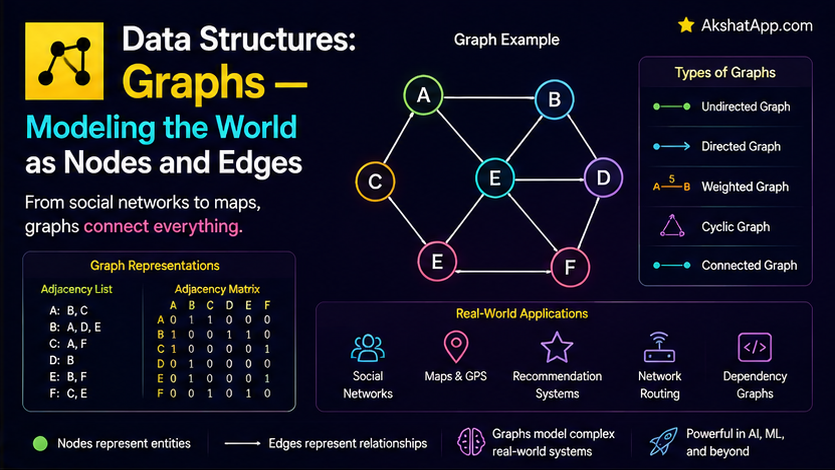
A graph consists of vertices (also called nodes — the same term used throughout Post #5) and edges, which connect pairs of vertices.
Directed vs. undirected: An undirected edge represents a mutual, symmetric relationship — a Facebook friendship, a road connecting two cities in both directions. A directed edge points one way only — a Twitter/X follow (following someone does not mean they follow you back), a one-way street, a package depending on another package.
Weighted vs. unweighted: A weighted edge carries an associated number — the distance between two cities, the cost of a network connection. An unweighted edge simply represents “connected” or “not connected,” with no additional value attached.
Representing Graphs in Code
Adjacency List
graph = {
    "A": ["B", "C"],
    "B": ["A", "D"],
    "C": ["A", "D"],
    "D": ["B", "C"],
}
Each key maps to a list of the vertices it directly connects to — genuinely efficient for graphs where each vertex connects to relatively few others (called “sparse” graphs), which describes the large majority of real-world graphs (a person has friends numbering in the hundreds, not millions; a webpage links to dozens of other pages, not every page on the internet).
Adjacency Matrix
#      A  B  C  D
# A  [ 0, 1, 1, 0 ]
# B  [ 1, 0, 0, 1 ]
# C  [ 1, 0, 0, 1 ]
# D  [ 0, 1, 1, 0 ]

matrix = [
    [0, 1, 1, 0],
    [1, 0, 0, 1],
    [1, 0, 0, 1],
    [0, 1, 1, 0],
]
A 2D grid where matrix[i][j] = 1 indicates a connection between vertex i and vertex j. This makes checking “are these two specific vertices connected” genuinely instant (a single array lookup, directly using Post #3’s array coverage), but wastes considerable memory for sparse graphs — a matrix representing a million vertices with only a handful of connections each still allocates a million-by-million grid, overwhelmingly filled with zeros.
The practical guidance: adjacency lists are the more common real-world choice, specifically because most genuine real-world graphs are sparse.
Traversal: Breadth-First Search (Using a Queue)
BFS explores level by level — visiting every immediate neighbor before moving on to neighbors-of-neighbors, using exactly the queue covered in Post #3.
from collections import deque

def bfs(graph, start):
    visited = {start}
    queue = deque([start])
    order = []

    while queue:
        vertex = queue.popleft()  # FIFO — exactly Post #3's queue behavior
        order.append(vertex)
        for neighbor in graph[vertex]:
            if neighbor not in visited:
                visited.add(neighbor)
                queue.append(neighbor)

    return order


graph = {
    "A": ["B", "C"],
    "B": ["A", "D"],
    "C": ["A", "D"],
    "D": ["B", "C"],
}
print(bfs(graph, "A"))  # ['A', 'B', 'C', 'D']
This is precisely the same level-order traversal technique covered for trees in Post #5, generalized directly to graphs — the queue’s FIFO ordering naturally produces a breadth-first, level-by-level exploration pattern.
Traversal: Depth-First Search (Using a Stack, or Recursion)
DFS explores as deep as possible down one path before backtracking, using either an explicit stack (Post #3) or recursion (which uses the call stack, also covered in Post #3).
def dfs_recursive(graph, vertex, visited=None, order=None):
    if visited is None:
        visited = set()
        order = []
    visited.add(vertex)
    order.append(vertex)
    for neighbor in graph[vertex]:
        if neighbor not in visited:
            dfs_recursive(graph, neighbor, visited, order)
    return order


print(dfs_recursive(graph, "A"))  # ['A', 'B', 'D', 'C']
def dfs_iterative(graph, start):
visited = set()
stack = [start]
order = []
while stack:
vertex = stack.pop() # LIFO — exactly Post #3's stack behavior
if vertex not in visited:
visited.add(vertex)
order.append(vertex)
for neighbor in graph[vertex]:
if neighbor not in visited:
stack.append(neighbor)
return orderThe direct payoff worth noticing explicitly: BFS and DFS are, structurally, the exact same traversal algorithm, differing only in whether the “next vertex to visit” collection is a queue (BFS, FIFO, explore breadth-first) or a stack (DFS, LIFO, explore depth-first) — a genuinely elegant, concrete confirmation that Post #3’s coverage of stacks and queues was not abstract theory, but the literal mechanism determining two of the most important algorithms in this entire series.
Real-World Use Cases
Social networks: Friend/follower relationships are naturally modeled as a graph — “friends of friends” recommendations are a direct application of BFS, exploring outward level by level from a starting person.
Maps and navigation: Roads connecting locations form a weighted graph, with pathfinding algorithms (a more sophisticated relative of the BFS/DFS covered in this post) finding the shortest or fastest route between two points.
Dependency resolution: Software package dependencies, build systems, and task scheduling with prerequisites are all naturally modeled as directed graphs — determining a valid installation or execution order is a direct graph algorithm application (called topological sorting, beyond this introductory post’s scope but worth knowing exists).
Recommendation systems: “Users who liked this also liked…” recommendations frequently rely on graph structures connecting users and items, with traversal-based algorithms identifying relevant connections.
Web crawling: Search engines discovering pages by following links from page to page are performing graph traversal directly — every link is an edge, every page a vertex.
Common Mistakes and Gotchas
⚠️ Mistake 1: Forgetting to track visited nodes, causing infinite loops
def bad_dfs(graph, vertex):
    for neighbor in graph[vertex]:
        bad_dfs(graph, neighbor)  # BUG — no visited tracking, loops forever on any cycle!
Unlike Post #5’s trees, graphs can contain cycles — a path that loops back to an already-visited vertex — and without explicitly tracking visited nodes, exactly as every correct example in this post does, traversal can loop indefinitely.
⚠️ Mistake 2: Choosing an adjacency matrix for a genuinely sparse graph Covered above — this wastes substantial memory for real-world graphs where most vertices connect to only a small handful of others, which describes the overwhelming majority of practical graph applications.
⚠️ Mistake 3: Using BFS when DFS was the better fit, or vice versa BFS is naturally suited to “shortest path in an unweighted graph” and “explore nearby connections first” tasks; DFS is naturally suited to “does a path exist at all” and “explore one branch completely before considering alternatives” tasks — picking the wrong one produces a correct but needlessly inefficient or awkward solution for the specific problem.
⚠️ Mistake 4: Forgetting that a directed graph’s edges are not automatically bidirectional
graph = {"A": ["B"], "B": []} # A follows B, but B does NOT follow AAssuming a directed edge implies its reverse also exists is a genuine, common source of bugs when modeling real directed relationships like follows, dependencies, or one-way references.
Quick Reference
# Adjacency list (most common for sparse real-world graphs)
graph = {"A": ["B", "C"], "B": ["A"], "C": ["A"]}

# BFS — queue, level-by-level, shortest path in unweighted graphs
from collections import deque
def bfs(graph, start):
    visited, queue, order = {start}, deque([start]), []
    while queue:
        v = queue.popleft()
        order.append(v)
        for n in graph[v]:
            if n not in visited:
                visited.add(n)
                queue.append(n)
    return order

# DFS — stack (or recursion), depth-first, explore one path fully first
def dfs(graph, start):
    visited, stack, order = set(), [start], []
    while stack:
        v = stack.pop()
        if v not in visited:
            visited.add(v)
            order.append(v)
            stack.extend(graph[v])
return order| Representation | Space | Check if edge exists | Best For |
|---|---|---|---|
| Adjacency List | O(V + E) | O(degree of vertex) | Sparse graphs (most real-world cases) |
| Adjacency Matrix | O(V²) | O(1) | Dense graphs, frequent edge checks |
Exercises
Exercise 1 — Direct application
Using the bfs function from this post, write a function shortest_path_length(graph, start, end) that returns the number of edges in the shortest path between two vertices in an unweighted graph.
Exercise 2 — Slight variation
Write a function has_path(graph, start, end) -> bool using DFS that determines whether any path exists at all between two vertices, without needing to find the shortest one.
Exercise 3 — Real-world combination
Model a small set of software package dependencies as a directed graph (e.g., {"app": ["auth", "database"], "auth": ["database"], "database": []}), and use DFS to determine a valid installation order — installing each package’s dependencies before the package itself.
Exercise 4 — Open-ended challenge
Deliberately construct a graph containing a cycle, run the buggy bad_dfs pattern shown in this post’s mistakes section against it (in a safe, limited way — perhaps with a maximum iteration count to avoid an actual infinite loop), and confirm it fails to terminate the way a correctly visited-tracking version does.
FAQ
Q: Is a tree a special kind of graph? A: Yes — a tree is specifically a connected, acyclic (no cycles) graph with exactly one path between any two vertices; every tree is a graph, but not every graph is a tree, since graphs generally permit cycles and multiple paths between vertices that trees explicitly do not.
Q: Which is generally faster, BFS or DFS? A: Neither is inherently faster in the general case — both visit every reachable vertex exactly once, giving both the same overall time complexity; the right choice depends on what you are actually trying to find, covered directly in this post’s common mistakes section.
Q: Do I need to implement graph algorithms from scratch in real projects? A: Rarely for the core traversal algorithms covered in this post — most languages have well-established graph libraries, and many real-world graph problems (routing, dependency resolution) are handled by specialized, heavily optimized existing tools. Understanding the underlying mechanism remains valuable for reasoning correctly about what those tools are actually doing.
Q: What’s the difference between a “weighted shortest path” and what BFS finds? A: BFS finds the shortest path by number of edges (hops) in an unweighted graph — for a weighted graph, where edges have different costs, a different algorithm (commonly Dijkstra’s algorithm) is needed to account for those weights, genuinely beyond this introductory post’s scope but worth knowing exists as the next step beyond BFS.
Summary and Next Steps
You now understand graphs as the most general, flexible structure in this series — any node connecting to any other, directed or undirected, weighted or unweighted — and, genuinely satisfyingly, that BFS and DFS are the exact same underlying traversal algorithm, differing only in whether Post #3’s queue or stack drives the exploration order. This connects directly back to that earlier post, confirming those structures were never abstract theory disconnected from real algorithmic use.
Your next step: Complete Exercise 3 — modeling package dependencies and finding a valid install order via DFS — since this is one of the most immediately, practically recognizable real-world applications of everything this post has covered, directly relevant to any software project with genuine dependencies.
This concludes Module 2 of this series — every foundational data structure (arrays, linked lists, stacks, queues, hash tables, trees, and graphs) is now covered. The next module turns to algorithms: precisely measuring and comparing how efficiently code actually runs, starting with the notation that makes “efficient” a rigorous, comparable claim rather than a vague impression.
Last updated: August 2026.
Share This Post

Join our newsletter!
Get the latest developer guides, tutorials, and tips delivered straight to your inbox.