Every version of the task tracker so far has kept its tasks array sitting in the open — a global or module-level variable that any code anywhere in the file could reach in and modify directly, bypassing addTask or completeTask entirely. This works fine in a five-post learning project. It becomes a genuine liability in any real application, where uncontrolled access to shared state is one of the most common sources of bugs that are hard to trace back to their actual cause.
Closures — functions that remember the variables from the scope they were created in, even after that scope has technically finished executing — are JavaScript’s answer to this problem, and they enable something Post #2 promised but did not fully explain: exactly why the let-in-a-loop fix works at the mechanical level. This post covers scope precisely, closures in full depth, the closure-based Module Pattern for genuine data privacy, and gives the task tracker real encapsulation for the first time in this series.
The Mental Model: Scope Is “Where Can This Variable Be Seen”
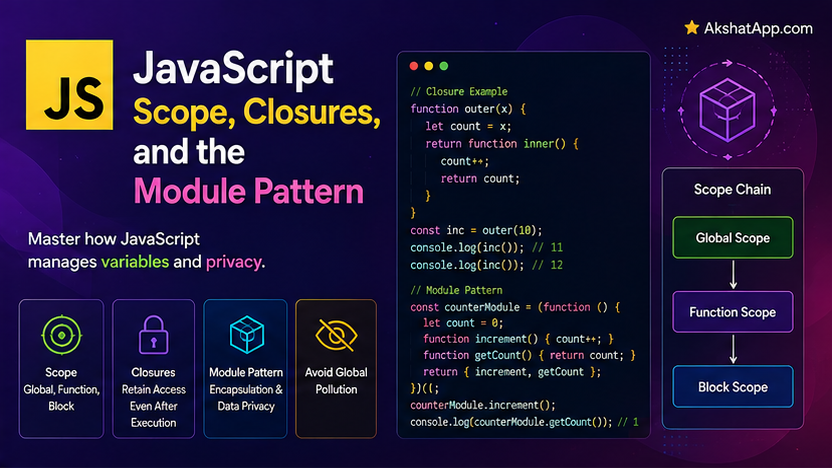
Scope determines where in your code a given variable is visible and accessible. JavaScript has four levels, from broadest to narrowest:
Global scope: Declared outside any function or block — visible from literally anywhere in the program, including every module that shares that global context (in a browser, attached to the window object; in Node.js, module-scoped by default rather than truly global, covered further in Post #12).
Module scope: In any file using ES modules (import/export, covered fully in Post #12), top-level variables are scoped to that specific file, not shared globally by default — a meaningfully safer default than older, non-module JavaScript.
Function scope: Variables declared with var inside a function are visible throughout that entire function, regardless of nested blocks — exactly the behavior covered in Post #2.
Block scope: Variables declared with let or const inside any { } block — an if, a for loop, a bare block — are visible only within that specific block, exactly the block-scoping behavior that made let the correct default over var.
The Scope Chain
When JavaScript looks up a variable, it checks the current scope first, then works outward through each enclosing scope until it finds the variable or runs out of scopes to check:
const outer = "I'm in the outer scope";

function middle() {
    const middleVar = "I'm in the middle scope";

    function inner() {
        console.log(outer);     // found in the outer scope — works
        console.log(middleVar);  // found in the middle scope — works
    }

    inner();
}

middle();
inner() can see both outer and middleVar, because JavaScript’s scope lookup walks outward through every enclosing scope. This outward-walking lookup mechanism is precisely what makes closures possible.
Closures: Functions That Remember
A closure is a function that retains access to variables from the scope it was created in, even after that outer scope has finished executing and would normally have disappeared.
function makeCounter() {
    let count = 0;
    return function () {
        count++;
        return count;
    };
}

const counter1 = makeCounter();
const counter2 = makeCounter();

console.log(counter1()); // 1
console.log(counter1()); // 2
console.log(counter2()); // 1 — completely independent from counter1
makeCounter() runs, creates count, and returns an inner function. Normally, count would cease to exist the moment makeCounter finishes running — but because the returned function references count, JavaScript keeps it alive, privately, attached specifically to that returned function. counter1 and counter2 are two separate calls to makeCounter(), so each gets its own independent count, permanently and privately remembered by its own specific closure.
The Closure-in-a-Loop Bug: Post #2’s Lesson, Explained at the Mechanical Level
Post #2 demonstrated that var in a loop with setTimeout produces 3 3 3 instead of 0 1 2, and fixed it with let, without fully explaining the underlying mechanism. Now, with closures properly covered, here is exactly why:
function createButtonHandlers() {
    const handlers = [];
    for (var i = 0; i < 3; i++) {
        handlers.push(function () {
            console.log(`Button ${i} clicked`);
        });
    }
    return handlers;
}

const handlers = createButtonHandlers();
handlers[0](); // "Button 3 clicked" — WRONG, expected "Button 0"
handlers[1](); // "Button 3 clicked" — WRONG
handlers[2](); // "Button 3 clicked" — WRONG
Every function pushed into handlers is a closure — each one closes over the variable i from the enclosing scope. Because var is function-scoped, there is only one i for the entire loop, and all three closures reference that exact same, shared i. By the time any handler is actually called, the loop has finished, and i holds its final value: 3.
function createButtonHandlers() {
    const handlers = [];
    for (let i = 0; i < 3; i++) {
        handlers.push(function () {
            console.log(`Button ${i} clicked`);
        });
    }
    return handlers;
}

const handlers = createButtonHandlers();
handlers[0](); // "Button 0 clicked" — correct
handlers[1](); // "Button 1 clicked" — correct
handlers[2](); // "Button 2 clicked" — correct
Because let is block-scoped, JavaScript creates a genuinely new i for every single iteration of the loop — each closure captures its own distinct i, not a shared one. This is the precise mechanical reason let fixes the bug: it is not a special “loop-aware” feature of let specifically — it is closures correctly capturing a fresh variable per iteration, because block scope creates a fresh binding on every pass through the loop, exactly as promised (without full mechanical explanation) back in Post #2.
Practical Uses of Closures
Private State (Data Encapsulation)
function createBankAccount(initialBalance) {
    let balance = initialBalance; // private — no external code can reach this directly

    return {
        deposit(amount) {
            balance += amount;
            return balance;
        },
        withdraw(amount) {
            if (amount > balance) {
                console.log("Insufficient funds");
                return balance;
            }
            balance -= amount;
            return balance;
        },
        getBalance() {
            return balance;
        },
    };
}

const account = createBankAccount(100);
console.log(account.getBalance()); // 100
account.deposit(50);
console.log(account.getBalance()); // 150
console.log(account.balance);        // undefined — balance is genuinely private
balance cannot be accessed or modified from outside except through the three methods explicitly provided — no account.balance = 1000000 shortcut exists, because balance was never attached to the returned object at all. It exists only inside the closure, privately, accessible solely through the functions that were deliberately given access to it.
Factory Functions
function createMultiplier(factor) {
    return function (x) {
        return x * factor;
    };
}

const double = createMultiplier(2);
const triple = createMultiplier(3);

console.log(double(5)); // 10
console.log(triple(5));  // 15
Each call to createMultiplier produces a genuinely independent function, permanently configured with its own factor — a pattern for generating specialized functions from a general template.
Memoization (Caching Expensive Results)
function memoize(fn) {
    const cache = new Map();
    return function (...args) {
        const key = JSON.stringify(args);
        if (cache.has(key)) {
            console.log("Cache hit!");
            return cache.get(key);
        }
        const result = fn(...args);
        cache.set(key, result);
        return result;
    };
}

function slowSquare(n) {
    console.log("Computing...");
    return n * n;
}

const fastSquare = memoize(slowSquare);
fastSquare(5); // "Computing..." then 25
fastSquare(5); // "Cache hit!" then 25 — no recomputation
cache lives inside memoize’s closure, privately shared across every call to the returned function — directly analogous to a caching pattern covered in this blog’s Python series, using closures to achieve the identical result in JavaScript’s own idiom.
The Module Pattern: Closures as Encapsulation, Before ES Modules Existed
Before JavaScript had built-in import/export (covered fully in Post #12), closures were the primary tool for genuine data privacy at the file level, using a pattern called an IIFE — Immediately Invoked Function Expression.
(function () {
    console.log("This runs immediately, the moment this line executes.");
})();
The outer parentheses turn what would otherwise be parsed as a function declaration (which requires a name) into a function expression instead; the trailing () calls it immediately. Combined with a returned object exposing only specific, intended functionality, this produces the Module Pattern:
const TaskModule = (function () {
    // Private state — invisible outside this IIFE
    let tasks = [];

    // Private helper function — also invisible outside
    function validateDescription(description) {
        return typeof description === "string" && description.trim().length > 0;
    }

    // Public API — the only things accessible from outside
    return {
        addTask(description) {
            if (!validateDescription(description)) {
                console.log("Invalid task description.");
                return;
            }
            tasks.push({ description, completed: false });
            console.log(`Added: "${description}"`);
        },
        completeTask(index) {
            if (index < 0 || index >= tasks.length) {
                console.log("Invalid task number.");
                return;
            }
            tasks[index] = { ...tasks[index], completed: true };
        },
        getTasks() {
            return [...tasks]; // return a COPY — external code cannot mutate the private array directly
        },
        getCount() {
            return tasks.length;
        },
    };
})();

TaskModule.addTask("Learn closures");
TaskModule.addTask("Understand the Module Pattern");
console.log(TaskModule.getCount()); // 2
console.log(TaskModule.tasks);        // undefined — genuinely private, no way to reach it directly
This is a meaningfully different guarantee than every previous version of the task tracker in this series provided. TaskModule.tasks does not exist as an accessible property — the actual tasks array lives entirely inside the IIFE’s closure, reachable only through the deliberately exposed methods. External code cannot do TaskModule.tasks.push(...) to bypass validation, cannot accidentally overwrite the array, and cannot inspect or corrupt internal state in any way the module’s author did not explicitly permit.
Worth stating directly: modern ES modules (Post #12) and class private fields (Post #7’s #privateField syntax) provide this same genuine encapsulation more directly and with cleaner syntax in current JavaScript. The Module Pattern shown here remains valuable to understand deeply for two reasons: it explains, at a mechanical level, why modules and private fields work the way they do, and you will still encounter this exact pattern in older libraries and codebases that predate more modern alternatives.
Real-World Use Cases
Protecting internal state in libraries: Any published JavaScript library that needs to prevent consumers from directly manipulating its internal data typically uses closures (via the Module Pattern, ES modules, or class private fields) for exactly this reason.
Event handler factories: Generating multiple, independently-configured event handlers — each remembering its own specific configuration — is a closure-based pattern used constantly in UI code, directly building on the factory function pattern covered in this post.
Avoiding global namespace pollution: Before ES modules existed, wrapping an entire script in an IIFE was the standard way to prevent variables from leaking into the global scope and potentially colliding with variables from other scripts loaded on the same page — a real, common problem in pre-module JavaScript.
Caching and rate-limiting: The memoization pattern demonstrated in this post is a direct, practical technique used in real performance-sensitive code, anywhere an expensive computation or API call is likely to be repeated with the same arguments.
Common Mistakes and Gotchas
⚠️ Mistake 1: The var-in-a-loop closure bug
Covered in full mechanical detail above — this is the single most important closure-related mistake to understand precisely, since it explains a real bug pattern from Post #2 at a deeper level rather than treating the let fix as an unexplained rule to memorize.
⚠️ Mistake 2: Assuming closures automatically make code slower or leak memory Closures do keep their captured variables alive in memory for as long as the closure itself exists — a genuine consideration for very long-lived closures holding references to large data structures, but not a concern for the vast majority of typical closure use, including everything demonstrated in this post.
⚠️ Mistake 3: Forgetting to return a copy of private data
getTasks() {
    return tasks; // BUG — returns the actual private array, not a copy!
}
Without the spread-based copy (return [...tasks];, exactly as TaskModule does), external code receiving the “private” array back could still mutate it directly, defeating the entire purpose of the encapsulation — a subtle but genuinely important detail easy to miss.
⚠️ Mistake 4: Overusing the IIFE Module Pattern in modern code with ES modules already available
For any project already using ES modules (which is the overwhelming majority of modern JavaScript, covered in Post #12), reaching for the IIFE pattern is usually unnecessary — export/import provides equivalent or better encapsulation with considerably less unusual-looking syntax.
⚠️ Mistake 5: Confusing “closure” with simply “a nested function”
Every nested function technically has access to its enclosing scope while that scope is actively running. What specifically makes something a closure is that the inner function retains that access after the outer function has already finished executing — exactly what makes makeCounter’s returned function, or TaskModule’s public methods, genuinely closures rather than merely nested functions.
Performance Note
Closures carry a small memory cost — the captured variables are kept alive in memory for as long as any closure referencing them exists, rather than being freed the moment the enclosing function returns, as would normally happen. For the scale of state typical in most application code (a handful of variables, small collections), this cost is negligible. It becomes a genuine consideration specifically with very long-lived closures (event handlers that persist for a page’s entire lifetime, closures capturing very large data structures) — Post #15’s V8-focused performance coverage addresses memory profiling directly, including how to identify closures that are unexpectedly keeping large amounts of data alive longer than intended.
Quick Reference
// Basic closure
function outer() {
    const value = "remembered";
    return function () {
        return value; // still accessible after outer() has finished
    };
}

// The closure-in-a-loop fix (mechanical explanation, not just the rule)
for (let i = 0; i < 3; i++) {
    // each iteration gets its OWN i — let is block-scoped, creating a fresh binding per pass
    setTimeout(() => console.log(i), 100);
}

// Private state via closure
function createCounter() {
    let count = 0;
    return {
        increment() { count++; return count; },
        reset() { count = 0; },
    };
}

// IIFE — Immediately Invoked Function Expression
(function () {
    // runs immediately, variables here are scoped to this function alone
})();

// Module Pattern — IIFE + returned public API
const MyModule = (function () {
    let privateState = 0;
    return {
        publicMethod() { return privateState; },
    };
})();
Exercises
Exercise 1 — Direct application
Write a closure-based createIdGenerator() that returns a function generating a new, incrementing unique ID every time it is called (starting from 1), with the current counter kept fully private inside the closure.
Exercise 2 — Slight variation
Reproduce the exact var-in-a-loop closure bug from this post using a fresh example (not button handlers — pick your own scenario), confirm you see the wrong shared value, then fix it with let and confirm each closure now captures its own independent value.
Exercise 3 — Real-world combination
Extend the memoize function from this post so that it also logs how many total cache hits versus cache misses have occurred across all calls — with that hit/miss count itself kept private inside memoize’s closure, accessible only through a method the memoized function exposes.
Exercise 4 — Open-ended challenge
Convert TaskModule from this post’s Module Pattern into a version using genuine ES module export/import syntax instead of the IIFE — even though Post #12 covers modules formally, attempt this now using what you can infer from this post’s coverage of the underlying encapsulation goal, and compare the result’s readability to the IIFE version.
FAQ
Q: Do I need to manually “clean up” a closure to free its memory? A: No — JavaScript’s garbage collector automatically frees a closure’s captured variables once nothing references the closure itself anymore (no remaining variable holding it, no event listener still attached, and so on). The concern in long-lived applications is usually about not knowing something is still being referenced somewhere, keeping memory alive unintentionally, rather than needing manual cleanup for closures used normally.
Q: Is the Module Pattern still worth learning if ES modules exist? A: Yes, specifically for the conceptual understanding — it demonstrates precisely how closures achieve data privacy at a mechanical level, which deepens your understanding of why ES modules and private class fields work the way they do, even though you will rarely write a fresh IIFE-based module in new code today.
Q: Can arrow functions create closures the same way regular functions do?
A: Yes, identically — closures are a property of any function capturing variables from its enclosing scope, regardless of which of the four function syntaxes from Post #3 is used. The this-binding differences covered in Post #3 are a separate, distinct topic from closures specifically.
Q: Why did getTasks() need to return a copy ([...tasks]) instead of the array directly?
A: Returning the actual private array directly would hand external code a genuine reference to it — meaning code outside the module could still call .push() or otherwise mutate the “private” data directly, exactly defeating the purpose of the encapsulation the Module Pattern is meant to provide. Returning a shallow copy (covered in Post #4) preserves the intended boundary.
Summary and Next Steps
You now understand scope precisely across all four levels, understand closures deeply enough to explain — not just apply — why let fixes the classic loop bug from Post #2, and can use closures practically for private state, factory functions, and memoization. The task tracker, via TaskModule, has genuine data privacy for the first time in this series — its internal tasks array is no longer directly reachable from outside code.
Your next step: Complete Exercise 2 — deliberately reproducing and then fixing the closure-in-a-loop bug in a fresh example of your own design — since building your own version of this bug, rather than only reading someone else’s, is what turns “I understand why this happens” into genuine, transferable intuition.
Code tested with Node.js 22 LTS. Last updated: July 2026.
Share This Post

Join our newsletter!
Get the latest developer guides, tutorials, and tips delivered straight to your inbox.