Recursion has been used constantly across this series without ever being formally explained: Post #5’s BSTNode.search calling itself on a subtree, Post #6’s dfs_recursive calling itself on each neighbor, Post #8’s merge_sort and quicksort both calling themselves on smaller sublists. Every one of these worked, on the promise that this post would eventually explain the underlying mechanism precisely. This is that post — and it connects directly back to Post #1’s CPU mechanics and Post #3’s stack coverage, because a recursive function calling itself is not a special language feature operating by different rules; it is the exact same call stack mechanism every function call already uses, applied to a function calling itself instead of a different function.
What Recursion Actually Is
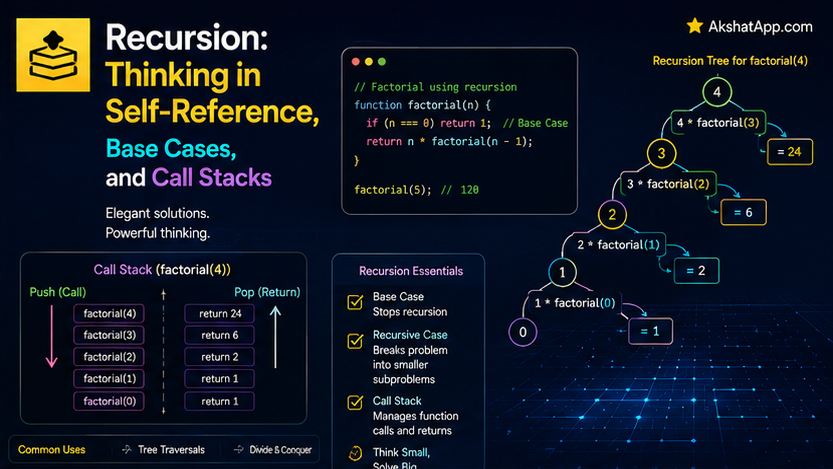
A recursive function is simply a function that calls itself, working toward a base case — a condition simple enough to answer directly, without any further recursive calls.
def factorial(n: int) -> int:
    if n == 0:            # BASE CASE — the simplest possible input, answered directly
        return 1
    return n * factorial(n - 1)  # RECURSIVE CASE — solve a smaller version, combine with n

print(factorial(5))  # 120
Every recursive function needs exactly these two pieces: a base case that stops the recursion, and a recursive case that reduces the problem toward that base case with each call. Without a genuine base case — or without the recursive case actually making progress toward it — recursion never terminates, covered directly in this post’s mistakes section.
The Call Stack, Made Concrete
Post #1 mentioned the call stack conceptually; Post #3 covered stacks as a data structure. Recursion is where these two ideas become directly, concretely connected: every function call — recursive or not — pushes a new frame onto the call stack, holding that call’s local variables and exactly where to resume once it returns. A recursive call is simply another push onto this same stack, using the identical mechanism as any other function call.
def factorial(n: int) -> int:
    print(f"Calling factorial({n})")
    if n == 0:
        print("Base case reached, returning 1")
        return 1
    result = n * factorial(n - 1)
    print(f"factorial({n}) returning {result}")
    return result

factorial(3)
Calling factorial(3)
Calling factorial(2)
Calling factorial(1)
Calling factorial(0)
Base case reached, returning 1
factorial(1) returning 1
factorial(2) returning 2
factorial(3) returning 6Notice the shape: calls stack up, reach the base case, then unwind in exactly reverse order — precisely the LIFO behavior Post #3 covered for stacks generally, now visible directly in a recursive function’s actual execution trace. factorial(3) cannot finish computing until factorial(2) returns, which cannot finish until factorial(1) returns, which cannot finish until factorial(0) — the base case — returns first.
Base Cases: What Happens Without One
def broken_countdown(n):
    print(n)
    return broken_countdown(n - 1)  # BUG — no base case, no stopping condition at all!

broken_countdown(5)
# RecursionError: maximum recursion depth exceeded
Without a genuine base case — or a recursive case that fails to actually approach one — the call stack grows without bound, one frame per call, until it exhausts the memory allocated for it (directly connecting to Post #1’s memory coverage) and the program crashes with a stack overflow error. This is not a rare or exotic bug — it is one of the most common mistakes in recursive code, covered in full in this post’s mistakes section.
Classic Example: Fibonacci, and a Direct Payoff of Post #7
def fibonacci(n: int) -> int:
    if n <= 1:              # base case
        return n
    return fibonacci(n - 1) + fibonacci(n - 2)  # recursive case

print(fibonacci(10))  # 55
This is correct — and it is also a genuinely excellent, concrete demonstration of Post #7’s exponential complexity class, O(2ⁿ), made vivid through real, measurable behavior rather than abstract description.
call_count = 0

def fibonacci_counted(n):
    global call_count
    call_count += 1
    if n <= 1:
        return n
    return fibonacci_counted(n - 1) + fibonacci_counted(n - 2)

fibonacci_counted(10)
print(call_count)  # 177 — far more calls than 10 would suggest

call_count = 0
fibonacci_counted(30)
print(call_count)  # 2,692,537 — an explosive, exponential increase for a modest increase in n
The reason: fibonacci(5) calls fibonacci(4) and fibonacci(3) — but fibonacci(4) also calls fibonacci(3) internally, recomputing an already-computed value from scratch. This redundant recomputation compounds at every level, producing exactly the doubling-with-each-additional-input pattern Post #7 described as O(2ⁿ). This specific, wasteful pattern — a recursive function re-solving identical subproblems repeatedly — is precisely the problem Post #11’s dynamic programming directly and specifically fixes.
Recursion vs. Iteration: Genuine Tradeoffs
# Recursive
def sum_recursive(numbers, index=0):
    if index == len(numbers):
        return 0
    return numbers[index] + sum_recursive(numbers, index + 1)

# Iterative
def sum_iterative(numbers):
    total = 0
    for n in numbers:
        total += n
    return total
Both correctly compute the same result. Recursion’s advantage: for genuinely self-referential, hierarchical problems — tree traversal (Post #5), graph traversal (Post #6), divide-and-conquer sorting (Post #8) — the recursive version frequently reads as a considerably more direct, natural translation of the problem’s own structure. Iteration’s advantage: it avoids consuming call stack space entirely, and for simple, linear problems like summing a list, it is both more memory-efficient and, in most languages including Python, meaningfully faster, since it avoids the overhead of repeated function calls.
The practical guidance: reach for recursion specifically when a problem is naturally self-similar or hierarchical (trees, graphs, divide-and-conquer); reach for iteration for simple, linear accumulation tasks where recursion adds conceptual elegance without a corresponding practical benefit.
Tracing a Recursive Call Step by Step
For factorial(3), the call stack’s actual state at its deepest point:
┌─────────────────┐  ← top of stack (most recently called, executing now)
│ factorial(0)      │  waiting to return 1
├─────────────────┤
│ factorial(1)      │  waiting on factorial(0), will compute 1 * 1
├─────────────────┤
│ factorial(2)      │  waiting on factorial(1), will compute 2 * 1
├─────────────────┤
│ factorial(3)      │  waiting on factorial(2), will compute 3 * 2
└─────────────────┘  ← bottom of stack (called first)
Each frame genuinely waits, paused, for the call above it to return — exactly Post #3’s LIFO stack behavior, with the deepest, most recent call resolving first, and each frame above it resuming and completing in turn as the stack unwinds back down to the original call.
Real-World Use Cases
Tree and graph traversal: Post #5’s BST operations and Post #6’s DFS are naturally recursive, since both problems are inherently self-similar — searching a subtree is structurally identical to searching the whole tree, just smaller.
Divide-and-conquer algorithms: Post #8’s merge sort and quicksort both rely on recursion directly, splitting a problem into smaller versions of itself and combining the results.
Parsing nested structures: JSON, HTML, and any genuinely nested data format are naturally processed recursively, since a nested object can itself contain further nested objects of the identical shape.
Mathematical definitions that are inherently self-referential: Factorial and Fibonacci, both covered in this post, are defined in terms of themselves in their own standard mathematical definitions — recursion is a genuinely direct translation of the definition itself, not an artificial imposition.
Common Mistakes and Gotchas
⚠️ Mistake 1: Missing or unreachable base case Covered at length above — always confirm both that a base case exists and that every recursive call genuinely progresses toward it.
⚠️ Mistake 2: Using naive recursion for a problem with overlapping subproblems Covered directly above with Fibonacci — a genuinely important pattern to recognize, since it is precisely the motivation for Post #11’s dynamic programming.
⚠️ Mistake 3: Exceeding the maximum recursion depth on unexpectedly deep input
Python’s default recursion limit is a genuine, real constraint — processing a deeply nested structure or a very long list recursively can hit this limit even with entirely correct logic; an iterative approach, or Python’s sys.setrecursionlimit() (used cautiously), are the two standard responses.
⚠️ Mistake 4: Forgetting that each recursive call has its own separate local variables
def confusing(n, total=0):
    total += n  # this modifies THIS call's local 'total', not a shared one across calls
    if n == 0:
        return total
    return confusing(n - 1, total)
Each stack frame genuinely has its own independent copy of local variables — a common point of confusion for anyone expecting recursive calls to share and mutate a single variable the way a loop’s variables persist across iterations.
Quick Reference
def recursive_function(input):
    if base_case_condition:       # BASE CASE — always required
        return simple_answer
    smaller_input = reduce(input)   # progress toward the base case
    return combine(input, recursive_function(smaller_input))  # RECURSIVE CASE

# The call stack: calls push, base case reached, then unwind in reverse (LIFO)| Use Case | Recursion or Iteration? |
|---|---|
| Tree/graph traversal | Recursion (natural fit) |
| Divide-and-conquer (sorting) | Recursion (natural fit) |
| Simple linear accumulation (sum, max) | Iteration (more efficient) |
| Deeply nested input, stack limit risk | Iteration (safer) |
Exercises
Exercise 1 — Direct application
Write a recursive function sum_digits(n: int) -> int that returns the sum of a positive integer’s digits (e.g., sum_digits(123) returns 6), identifying the base case and recursive case explicitly in comments.
Exercise 2 — Slight variation
Add print statements to your sum_digits function, exactly as this post did for factorial, and trace through sum_digits(123)’s complete call stack behavior by hand before running it.
Exercise 3 — Real-world combination
Write a recursive function count_nested_items(data) -> int that counts the total number of elements in a nested list structure (a list that may contain other lists, to any depth) — directly applying this post’s “parsing nested structures” use case.
Exercise 4 — Open-ended challenge
Using this post’s fibonacci_counted pattern, measure the actual call count for fibonacci(35), and estimate how long the naive recursive version would take to compute fibonacci(50) based on the growth pattern you observe — without actually running it, since the real answer would likely take an impractically long time, a genuinely concrete confirmation of O(2ⁿ)’s real-world impracticality.
FAQ
Q: Is recursion always slower than the equivalent iterative solution? A: Generally, yes, due to function call overhead — but the difference is often negligible for reasonable input sizes, and recursion’s clarity advantage for naturally self-similar problems (trees, graphs, divide-and-conquer) frequently outweighs the modest performance cost.
Q: Why do some languages optimize recursion (tail-call optimization) while Python doesn’t? A: Tail-call optimization allows certain recursive patterns to reuse stack frames instead of growing the stack indefinitely — a genuine language design choice some languages make and Python deliberately does not, meaning Python code relying on very deep recursion should generally prefer an iterative rewrite rather than assuming this optimization will save it.
Q: Can every recursive function be rewritten iteratively?
A: Yes, in principle — any recursive algorithm can be converted to an iterative one, typically using an explicit stack (Post #3) to manually manage what the call stack was previously handling automatically, exactly as Post #6’s dfs_iterative demonstrated directly as an alternative to dfs_recursive.
Q: How is recursion related to mathematical induction? A: Very closely — both rely on the same underlying structure: prove/handle a base case directly, then show/compute how a larger case reduces to a smaller one already handled. Recursion is, in a genuine sense, mathematical induction expressed as executable code.
Summary and Next Steps
You now understand recursion as exactly what it has been the entire time it appeared throughout this series — a function calling itself, using the identical call stack mechanism Post #1 and Post #3 already covered for every function call, requiring a genuine base case to avoid the stack overflow covered directly in this post. Naive recursive Fibonacci’s exponential call count gives Post #7’s O(2ⁿ) complexity class a concrete, measurable, real-world demonstration — and sets up precisely the problem Post #11 solves directly.
Your next step: Complete Exercise 4 — estimating naive Fibonacci’s impracticality at larger inputs without actually running it — since genuinely internalizing just how explosively O(2ⁿ) growth compounds is the single most important intuition this post can leave you with, directly motivating why the next post’s technique exists at all.
Last updated: August 2026.
Share This Post

Join our newsletter!
Get the latest developer guides, tutorials, and tips delivered straight to your inbox.