Post #1 opened with node --version and a task tracker holding two tasks in a plain array, printed with console.log. Nineteen posts later, that same conceptual project — the exact shape of data, { description, completed, priority }, unchanged since the very first post — has closures for genuine privacy, a real class hierarchy, custom errors, live API integration, a full test suite with mocked network calls, TypeScript interfaces enforcing its shape at compile time, browser and server-side persistence, and a real, bundled, deployable production build.
This final post looks at where the JavaScript language and its ecosystem are heading — genuine recent ECMAScript features building on Post #14’s toSorted() coverage, an honest, unhyped survey of the framework landscape that this series’ deliberately vanilla-JavaScript approach set aside until now, and a complete retrospective on the task tracker’s full twenty-post evolution.
Recent ECMAScript Features, Beyond Post #14’s toSorted()
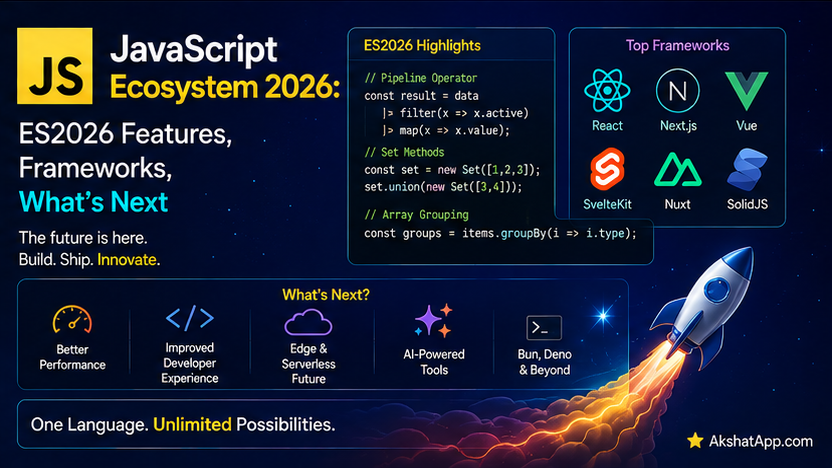
Object.groupBy and Map.groupBy (ES2024)
const tasks = [
    { description: "Learn JS", priority: "high" },
    { description: "Write tests", priority: "low" },
    { description: "Deploy app", priority: "high" },
];

const grouped = Object.groupBy(tasks, (task) => task.priority);
console.log(grouped);
// { high: [taskLearnJS, taskDeployApp], low: [taskWriteTests] }
Before this, grouping an array by some computed key required a manual reduce — exactly the kind of small, extremely common operation ES2024 promoted to a direct built-in. Map.groupBy works identically but produces a genuine Map instead of a plain object, useful specifically when your grouping keys are not guaranteed to be strings.
Promise.withResolvers (ES2024)
// Before — resolve/reject had to be captured via a side effect inside the executor
let resolveFn, rejectFn;
const promise = new Promise((resolve, reject) => {
    resolveFn = resolve;
    rejectFn = reject;
});

// ES2024 — direct, no awkward capture required
const { promise, resolve, reject } = Promise.withResolvers();
A small but genuinely welcome ergonomic improvement for the specific, recurring pattern of needing to resolve or reject a Promise from outside its own executor function — directly relevant to anyone building custom Promise-based utilities on top of Post #9’s foundations.
The Ongoing Trajectory
Each recent ECMAScript version has continued two consistent threads visible throughout this series: promoting extremely common manual patterns (grouping, the non-mutating array methods from Post #14) into direct built-ins, and continued refinement of the async and iterator ecosystems established since ES2017’s async/await. Nothing in this trajectory changes any fundamental this series has taught — every new feature slots directly into the mental models already built, exactly as toSorted() extended rather than replaced the array method knowledge from Post #4.
The Framework Landscape: An Honest, Brief Survey
This series has deliberately stayed within vanilla JavaScript throughout — every DOM manipulation in Post #10 was direct and manual, precisely so the underlying mechanics were never hidden behind a framework’s abstraction. Real, large-scale applications very often use a framework on top of everything covered so far, and understanding why is worth closing this series with, even without a full tutorial on any specific one.
The Problem Frameworks Solve
Post #10’s renderTasks() function took the simplest possible approach to keeping the DOM in sync with data: clear the entire list, rebuild it completely from scratch, every single time anything changes. This is honest, simple, and — as that post’s own performance note acknowledged — genuinely does not scale well to large, frequently-changing lists, since it discards and recreates every element regardless of what actually changed.
Frameworks solve this with a declarative model: you describe what the UI should look like for a given piece of state, and the framework determines the minimal actual DOM changes required to get there — without you manually tracking what changed and updating only that.
// Illustrative, conceptual pseudocode — not any single framework's exact syntax
function TaskList({ tasks }) {
    return tasks.map((task) => (
        <li className={task.completed ? "completed" : ""}>
            {task.description}
        </li>
    ));
}
// When 'tasks' changes, the framework compares the new desired output to
// what's currently on screen, and applies only the specific, minimal DOM
// updates needed — no manual clear-and-rebuild required
A Brief, Fair Survey
React: The most widely adopted option, component-based, with a large ecosystem and extensive available tooling and documentation. Historically used a “virtual DOM” diffing approach; recent versions have moved toward compiler-based optimization reducing the need for manual performance tuning.
Vue: Often considered more approachable for developers coming directly from vanilla JavaScript and HTML, using a template syntax closer to standard HTML with added reactivity, alongside a component model broadly similar in spirit to React’s.
Svelte: A meaningfully different philosophy — much of Svelte’s work happens at build time (directly building on Post #19’s compiler/bundler concepts), compiling components down to highly optimized, framework-runtime-free JavaScript, rather than shipping a general-purpose framework runtime to interpret components in the browser.
Meta-frameworks (Next.js for React, Nuxt for Vue, SvelteKit for Svelte): Add server-side rendering, file-based routing, and full-application concerns on top of their base framework — the layer most real, production applications actually build on, rather than the base framework alone.
The honest, unhyped takeaway: all of the above are genuinely capable, production-proven choices — the “best” one depends heavily on team familiarity, project requirements, and ecosystem needs far more than any inherent technical superiority of one over another. Every framework in this list is, underneath, built from the exact fundamentals this entire series has covered — closures, classes, modules, async/await, the DOM — making everything in this series directly transferable regardless of which framework, if any, a future project eventually adopts.
What’s Worth Watching, With Appropriate Hedging
Signals-based reactivity: A pattern for tracking exactly which specific pieces of state a given UI update depends on, enabling more surgical, automatic updates than older approaches — appearing independently across multiple frameworks in recent years, a genuine convergent trend worth being aware of as it continues maturing.
Server-first rendering patterns: Increasing emphasis on rendering more of an application’s initial output on the server (directly building on Post #18’s server-side Node.js coverage) before shipping JavaScript to the browser at all, improving initial load performance for content that does not need to be interactive immediately.
Continued TypeScript adoption: Post #16 already reflects TypeScript as close to a default expectation for professional JavaScript work in 2026 — this trajectory shows no sign of reversing, if anything continuing to deepen across the ecosystem’s tooling and libraries.
Build tooling continuing to consolidate around speed: Directly extending Post #19’s esbuild/Vite coverage — faster, often systems-language-based tooling (Go, Rust) replacing older, slower JavaScript-based equivalents is an ongoing, multi-year trend across the entire ecosystem, not specific to any one tool.
None of this is guaranteed to land on any particular timeline — offered as genuine, informed direction rather than certainty, exactly the same epistemic care this blog’s other technical series apply to forward-looking claims about their own respective ecosystems.
The Task Tracker’s Complete Journey
A direct retrospective, post by post, on the single project that ran throughout this entire series:
Post #1: A plain array, three standalone functions, console.log output — functional, but with no real structure.
Post #3: Understanding every loop type and control flow construct, in preparation for everything built on top of them.
Post #4: Refactored into an object with methods, using destructuring and array methods properly for the first time.
Post #6: Genuine data privacy via a closure-based Module Pattern — TaskModule.tasks became truly inaccessible from outside for the first time.
Post #7: A real class, with private fields (#tasks), inheritance (ProjectTaskList extends TaskList), and getters.
Post #8: Proper custom errors — BankAccount genuinely refuses invalid operations instead of merely logging about them.
Post #9: Simulated async load/save via setTimeout, establishing the async/await patterns used for the rest of the series.
Post #10: A real, clickable browser interface — event delegation, forms, and the textContent-over-innerHTML security discipline.
Post #11: The simulation replaced entirely — genuine fetch calls to a live API, with the critical response.ok check properly handled.
Post #12: Split across four properly-scoped ES modules — taskUtils.js, api.js, TaskManager.js, main.js.
Post #13: A real test suite, including mocked fetch calls, running in milliseconds with zero network dependency.
Post #14: Refactored toward pure functions and immutable updates, specifically avoiding the sort()/splice() mutation gotcha with toSorted().
Post #16: Fully typed with TypeScript — the Task shape, informal since Post #1, finally compiler-enforced.
Post #17: Permanent localStorage persistence — surviving a page reload with zero server involvement for the first time.
Post #18: Genuine server-side file persistence via Node’s fs/promises, with proper ENOENT handling.
Post #19: Bundled, minified, and tree-shaken into a real, deployable dist/ folder via Vite.
The core data shape — a task with a description, a completion status, and a priority — has not changed once since Post #1. Everything surrounding it reflects every single lesson this series has covered.
Final Capstone Exercise
Bring the entire series together one final time. Add a “tags” feature to the task tracker, implementing it completely:
- Add an optional
tags?: string[]field to the TypeScriptTaskinterface (Post #16) - Update
createTaskto accept an optional tags parameter, with proper validation (Post #7/#8) - Add a pure function
filterTasksByTag(tasks, tag)following Post #14’s immutability discipline - Write tests for it, including the empty-tags case (Post #13)
- Update the DOM rendering to display tags, using
textContentcorrectly for the security discipline from Post #10 - Persist the new field correctly in both
localStorage(Post #17) and the server-side file storage (Post #18) - Run
npm run build(Post #19) and confirm the production bundle still works correctly with the new field
Completing this exercise end to end is the clearest possible confirmation that twenty posts’ worth of individual lessons have combined into one genuinely coherent, professional workflow.
FAQ
Q: Should I learn a framework immediately after finishing this series? A: If your next project genuinely calls for one — most real, larger applications do — yes, and you are considerably better prepared for it than someone skipping directly to a framework without these fundamentals, since every framework is built from exactly what this series covered. If your immediate needs are smaller in scope, continuing to build directly in vanilla JavaScript, exactly as this series has, remains entirely valid.
Q: Is this series’ JavaScript knowledge going to become outdated quickly?
A: The fundamentals — closures, this, async/await, the module system, classes, the DOM — are stable and have been for years; new ECMAScript features (like this post’s Object.groupBy) extend rather than replace them, exactly as toSorted() extended Post #4’s array method coverage rather than deprecating it. The framework and build-tool layer is where things evolve faster, which is precisely why this series emphasized the durable fundamentals underneath, not today’s specific framework syntax.
Q: Why didn’t this series teach React or another framework directly?
A: A framework is easiest to learn well once the fundamentals it is built on top of are already solid — this, closures, the DOM’s actual behavior, and modules are things every framework either uses directly or works around, and understanding them first makes a framework’s own abstractions considerably more legible rather than feeling like arbitrary magic.
Q: What should I build next, now that the series is complete? A: Take a real problem from your own work or life and build it using this series’ full toolkit: proper module structure from the start, tests as you go, TypeScript throughout, and a real build and deployment step once it works. The task tracker’s twenty-post evolution is the template — apply it to something genuinely your own.
Series Conclusion
Twenty posts ago, this series opened by pointing out that JavaScript occupies a position no other language does — the only language every browser runs natively, also powering servers, mobile apps, and desktop applications. That claim was the premise; this series’ actual work has been making sure the fundamentals underneath that broad reach are genuinely, thoroughly understood — not pattern-matched from tutorials, but built, tested, broken, and fixed, on one consistent project across every post.
If you completed the exercises — not just read them, but wrote and ran the code — you now have real, demonstrated JavaScript proficiency: the language’s genuinely distinctive features (this, closures, the event loop, prototypes underneath classes) understood at a mechanical level, not just a “the docs said to do it this way” level, connected to real, working code you built yourself across twenty posts rather than twenty disconnected examples.
Your next step: Complete the final capstone exercise above. Then close this tab, and start something genuinely your own — npm create vite@latest, and a real first feature, not a console.log.
Last updated: July 2026. ECMAScript proposals and framework ecosystems evolve continuously — verify current feature support at caniuse.com and check each framework’s own documentation for its latest recommended approach.
⚠️ Framework descriptions in this post are intentionally high-level and illustrative, not tutorials — consult each framework’s official documentation before starting a real project with it.
Share This Post

Join our newsletter!
Get the latest developer guides, tutorials, and tips delivered straight to your inbox.